Overcoming Barriers to Communication
Contents:
1. Introduction
''Create opportunities by removing barriers to communication'' is the mission statement of this article. It reflects the experience of its author. It shows that most of human problems are related to Communication.
It is not surprise as communication is the essence of being human. Yet, it often suffers due to personal, cultural, and social differences. One may expect differences to be positive and enriching; practice however shows that it is not often the case. - Why is that?
- It seems that we sometimes perceive, cultures, religions, ethnicity, and peer group subcultures as deserving equal respect assuming that they are the foremost representation of individuals: A basic rhetorical mistake.
Is this a surprise? Not really. We do similar mistakes while classifying people:
young->inexperienced, old->useless, poor->incapable, rich->clever, etc.
While these or reverse relations might be true or not in different cases, we have to remember that they are not necessarily implications nor tautologies.
The idea of creating opportunities by removing or overcome barriers to communication makes the heart of the project I attempt to conduct. For this some cooperation is needed.
It is possible to identify several disadvantaged groups that need attention if it comes to communication problems. Here they are:
Disadvantaged groups:
2. Dealing with communication problems
While removing barriers to communication seems to be theoretically possible, the process itself might be very difficult, time consuming and finally ineffective.
Barriers, like weeds, grow and expand wherever they find a place to spread.
These places must be able to feed them in order to make them grow otherwise they die. What feeds the barriers to communication is information itself flowing through specially establish communication channels and only through them.
While crashing the barrier might be challenging, building simple communication bypasses seems to be more logical and effortless.
The same phenomenon applies to communication structures containing barriers. It's much easier to build new structures then decompose existing ones. On the other hand, rigid unreformable structures, while omitted by users, may become open to self-improvement and cooperation.
Communication is a power, which if properly released, may change positively everything and by creation of additional communication channels and networks we can make this happen.
To create new communication channels/networks we may need a structure and tools. To do that a project is needed and a a team to work on it. A non-profit organization supporting the initiatives might be one of possible solutions.
Farther development of some ideas may require technical/technological activities and can be done by creating different kind of organizations. Some projects may be set as commercial and some as not. The commercial projects should raise some money for the behalf of the participants accordingly to their work and the resources they brought or share.
3. Overcoming Barriers to Communication
Now, let's have a look at the Disadvantaged Groups (a-j) we have identified previously. In order to find methods to help them, we will analyze the communication barriers they face, then we will discuss solutions and communication channels that can be built to overcome the problems.
3-a. Disabled people with major communication problems

Disabled people may suffer from mobility problems, communication, lack of social skills and cognitive problems. They can mitigate their difficulties, using specially designed equipment. The price of equipment is usually high as market for such products, perceived narrow, makes development and production cost relatively high.
Globalization, fusion of markets, new communication tools and technology progress have brought opportunities to make positive changes in this situation. Assistive Technology (named for its assisting character toward disable people) has already emerged trying to find its place in the economy.
Disable people have been given hope, but smart, user-friendly equipment still has not arrived.
Some problems still remain difficult to overcome. They are related to specialization requirement.
Sure, people cannot be specialized in everything. The magic of low cost design and production remains in dividing whole process in many simples operations but the development stage requires much more cross-communication and cooperation of different specialists.
No doubt that effective development of assistive technology equipments requires four major elements.
Do any solutions to those problems exist? - They possibly do but their limits remain in the fact that they are rarely used together.
Firstly, the question of team. Several products have been already developed using open source project approach and virtual teams. This was especially true in software development.
Using PA (Partners Agreement) and NDA (Non Disclosure Agreements) any current teamwork developing any given product or service may extend its interest in later commercialisation .
Until final creation of the statutory rules such group takes place, the activities can be regulated by a set of Preliminary Rules.(Example)
Secondly, the question of technology. This problem was successfully resolved by gadgets' making industry in China. Design and production processes are separated. Many simple small companies and single entrepreneurs design their products. Successful designs in form of models, prototype and preliminary documentation are then transferred to companies specialized in mass production where they make subject of final redesign and commercialization. The use of typical mass production technology assures that the final products are inexpensive and have professional look.
Unfortunately as the first requirement is not always met the technical level of the product related to their functionality is often low, because of the lack of deeper professional and scientific knowledge of the designers. However, it is obvious that as experience of small companies grows and more professional support is given the products become better.
As it has been shown, the main problem remains in the creation of team. No surprise! Entrepreneurs are genuine individualists. They are in love in their ideas; they are jealous and suspicious.
They are also independent freedom-loving individuals, difficult to manage. It is hard to convince them to change their habitudes and the way they perceive the reality. They are making many mistakes*) but they are indispensable in any project and when bit converted and assigned to a team, they are able to make things happen.
*) Check the following:
A-Z Entrepreneurs Mistakes
Top Ten Mistakes Made by Entrepreneurs
There are two possible projects that may get our attention:
3-B. People facing language barriers
Language is the essential element in being human. No doubt, it reflects who you are, what you are and what you belong to. While the first information is usually delivered by visual contact, language itself may be even more preponderant element used to classify individual.
In the frame of nationality, language, its style, clarity, elegance and its vocabulary distinguish people accordingly to their origin, background, education, culture, including current personal social position and so on. This is the most important flag sent in communication which introduces individual.
In the global geopolitical frames language represents culture and nation. It flags its position in the global structure including political an economical relations. It calls for the previously gathered information including opinions and prejudice.
As we can see, language builds preliminary image of any individual. This image remains if no other communication processes coerce its change.
In the international interactions language barriers are very essential not only because they may make communication process problematic or difficult but also because their presence automatically engage much dipper process of cognition/recognition and cultural/intellectual estimation of individual. This estimation goes through both general impression and national/cultural frames but not necessarily equally. It searches also for other references like current status, position, job and other circumstances.
How all these are related to language barriers?
First, every position in the social grid requires a bunch of qualities including communication skills thus appropriate language.
Second, Language is powerful predominant, often overused, in determining people qualities.
Third, Absence or poor language often shifts related individual down to zero qualities.
This phenomenon is typical for some societies which believe to be on the higher development stage.
Fourth, If the proper language can be used but different accent is detected, the stranger is usually shifted down, accordingly to the estimated distance between cultures/countries development levels.
As we can see the language skill may affect the social position of individual. This phenomenon will be shown and explained in the next paragraph where we'll be talking about social shifts confronting migrating people when in foreign countries.
Searching for solutions to the problem of language.
To acquire good skill in any language one needs a time. Political and economical migration, which means people looking for better places, challenges hosting countries. Most of chalenges are related to communication and skills. Many states resolve the problems by organizing free language courses sponsored by the government and public organisations.
Some states make farther effort toward professional skills and education of the new-arrivals. The United Kingdom makes a good example. The additional, excellent access to the low cost professional courses facilitates problems of the new-arrivals.
The basic English learning system is well established and expected to produce good results. Dipper analysis, however, shows that the cost/results efficiency ratio is far from desired. Why is that?
Let's take an example from Canada. The basic language skill courses in this country are well organized and efficient while eventual farther professional education exposes several barriers.
In the United Kingdom the access to all courses is better but basic language courses look to be more correctional than basis centred and good-skill oriented. This phenomenon is related to the fact that the most of immigrating in the past people usually originated from ancient British territories where certain basic knowledge of English remained common.
It is typical for all immigration systems in the world to be rigid, retarded and unable to respond quickly to the current world changes. This is normal as they are based on the legislation systems.
Some parts of public educational systems if not stimulated remain inertial as well. To get better effect from both systems and make education process cost effective and fast governmental actions are needed. That requires some planning and redirection toward elasticity and adaptation to the current and future socio-economical needs and realities.
Projects and Actions
There are two possible project which may get our attention.
There are as many methods of teaching foreign language as persons trying to improve them. Unfortunately, most of them are not teachers but opportunists. They try to elaborate something new because new seems to be a synonym of better. What is finally new is the use of new technology and unfortunately only this.
As the matter of fact people have been learning the language from the beginning of its birth. No surprise that if it comes to children his process is well known and understood. The problems with so-called modern learning methods remain in a few erroneous believes. Here are some most important of them:
Learning and teaching language are natural things and we are very well prepared to do so. Learning language means mainly building structures, stereotypes and relations. The structures are built using words but not many words are needed to build a structure while many structures are needed to play with words.
Using structured groups of words means using language.
The language explains the world and actions by building mental projections and models of the world relations. Accordingly language learning should be directly related to the elements and actions perceived by our senses, i.e. images, sounds and feelings.
Learning language should be gradual but not necessary infantile. It should be learned as a whole but not as detached parts. The perception of a new language requires new language matrix and communication channels able to fetch information in the right place. That must be built through experience and training.
When natural method is used the language basic may be taught by almost anybody. Of course as usual we may have better and worst teachers the same way as we may have more and less skilled parents. The result depends on both teaching and learning person.
3-C. Skilled immigrants out of social grid
Hierarchies and Dominations
Basic human predisposition to form and maintain hierarchical, group based system is well known. Hierarchy builds structures and relations. Structures and relations are necessary for the system to be stable, adaptive and progressive.
Let's presume that the social system goal is to provide relatively equal well-being for all members of society. As there are many positions, functions, actions, responsibilities and other details in the system, it is not difficult to imagine that some combinations of these elements may function better, for the behalf of the system, than other. Consequently, We can then talk about optimal positions of individuals in the organisation. To allow the system to optimise itself, flexible and adaptive mechanisms, able to shift people position, are required. If they are present, the system can evolve and progress.
There is nothing wrong with hierarchy if based on knowledge, experience, honesty and other human qualities. People remain equal accordingly to the law and human rights while holding different positions and performing different tasks in the society. Their positions and responsibilities determine their social position, which reflects respect, recognition and standard of life. Any human domination based only on differences in the positions in the social grid is perceived as unwanted and harmful for the society.
Hierarchies and dominations are nothing new in the international politics. The presence of known international organizations, created to protect political groups from being dominated, reflects this situation.
The hierarchies based on leadership, engagement, friendship, appreciation and commitment were always proved to be beneficial in many structures and organisations, no matter, national or international. Right rules and right people in the right place rule make systems performing optimally with maximum benefits for all.
Social Degradation and Social Advance
The social position of individual may perceived from different viewpoints and may be:Formal - related to the holding responsibilities and the real formal position in the
society.
Informal - related to their background or simply to their wealth level, etc.
It reflects the perception of other people.
Personal - as perceived by the individual himself.
Let's analyze the social impact related to the physical displacement of the individual from the original political state to a different one marked by higher economical wealth.
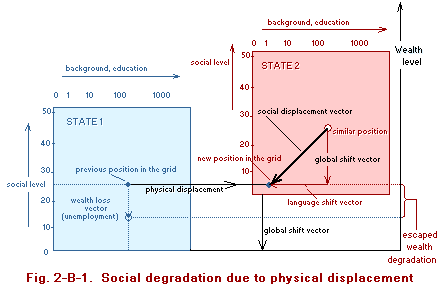
Dependently of the individual's background, social position, knowledge of the language of the destination state the situations after the displacement may be quite different. We may talk about social advance, social equality or social degradation. Let's have a look at some of them.
Fig. 3-B-1. shows simplified model of social degradation phenomena due to cause number 1, 3 and 4. It is important to mention that the general differences in wealth level of the states are transposed on background/education level so in this case even the individual with good communication skill is shifted down anyway. In this case we can talk about social protectionism or discrimination in the destination state and of course about socio-economical loss for the hosting state. See also a related fragment of the MRC report from June 2006
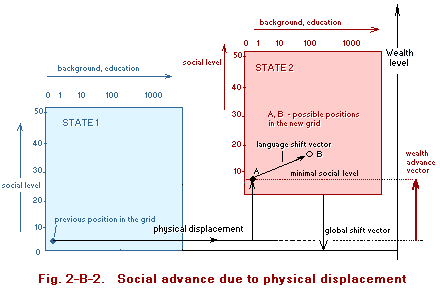
It is not the purpose of this article to explore and explain all possible combination, however it may be interesting to analyze one more case shown on the Fig.3-B-2.
This Fig.3-B-2. model shows that an individual from underdeveloped state after displacement to a higher developed state benefits the wealth level, which is often understood as social advance. Furthermore, because knowledge of the language is often mismatch with education level, when language skill of this individual is at certain non-zero level, the language related shift may place him at much higher social position than in the case of highly educated person with no language skill at all.
Placing individuals in the wrong places in the Social Grid creates resistance from both the individuals and the places. Those elements just do not fit. When the new position is caused by social degradation the situation may be even worst. The frustrated individual often leaves the wrong place the moment when there is no better place available. They feel like out of any grid which results in separation and loneliness.
Is the language improvement is the key to make positive shift happen?
- Yes, but language of the individual cannot be improved in the wrong social grid place because our individual learns the wrong one!
Simply because like the place like the language.
Projects and Actions
There are several possible projects that we can consider.
These projects of course require leaders.
3-D. Just Graduated
Just Graduated from Schools and Universities are lacking experience. Despite of the fact that you can sometimes find more black swans in a field than you might expect does not make this statement false.
What employers want, is to have highly skilled experienced workers qualified to do particular jobs. In the same time they do not want pay too much. It is normally hard to meet both requirements in conjunction.
Additionally, employers are looking for people to stay and grow within the company. This can be met by just graduated if only both sides are satisfied continuously. What is interesting in this issue is that highly qualify and experienced immigrants have similar problems as just graduated have. We'll try to explain this mystery later.
Of course the hired should match the vacancy, which is not always an easy task
There is a factor of narrow specialisation , which makes this requirement difficult to met.
Most jobs performed by people are divided into simple tasks requiring narrow skills. This tendency is dictated by economical reasons of reliability, quality and cost.
The education system is trying to follow the economy demand by providing low cost narrowed study on the one hand and general wider study on the other hand in a hope for farther adjustment. This does not help too much because of too many skill-positions combinations and evident lack of direct communication in the hiring process.
Let's face the reality!
First let's talk about experience. If we think experience we usually mean the relevant one not just any experience. Experience can be gotten by practice system during the study which requires more workshops in schools, more industry involvement and more voluntary works. Current proposition of the Conservative Party leader Mr. David Cameron makes a good example. More Hobby Clubs and other projects for youngsters can improve the situation as well.
Communication and Employment (to be moved to the other document)
Misemployment is a nightmare for both employers and hired. Unfortunately employers don't speak about this problem publicly. They blame usually everything but not themselves. Wrongly hired people just give up and try to adapt or quit. The situation is caused mainly by general communication problems, disinformation, and several structural barriers in place. Let's examine them one by one.
Everything starts with needs
Employment or hiring process is nothing but typical communication process. Unfortunately some people think that it is a game. Of course it may be perceive this way but we have to acknowledge that the best result of this game is when both sides win. This means cooperate. Game playing usually involves gains and losses. that is not desirable in making any employment choices. Of course salary negotiations which make parts of hiring processes involve game playing but this is another story.
Let's have a look at our communication principles and barriers already mentioned in the previous article.
How these principles and barriers can be translated to some truths related to hiring.
Let's try to formulate them.
to be continued...
3-E. Just Retired)
3-F. Older People
3-G. Baby boomers
3-H. Misunderstood visionaries
3-I. Socially rejected
3-J. Nomads
 About barriers

''Create opportunities by removing barriers to communication'' is the mission statement of this article. It reflects the experience of its author. It shows that most of human problems are related to Communication.
It is not surprise as communication is the essence of being human. Yet, it often suffers due to personal, cultural, and social differences. One may expect differences to be positive and enriching; practice however shows that it is not often the case. - Why is that?
- It seems that we sometimes perceive, cultures, religions, ethnicity, and peer group subcultures as deserving equal respect assuming that they are the foremost representation of individuals: A basic rhetorical mistake.
Is this a surprise? Not really. We do similar mistakes while classifying people:
young->inexperienced, old->useless, poor->incapable, rich->clever, etc.
While these or reverse relations might be true or not in different cases, we have to remember that they are not necessarily implications nor tautologies.
The idea of creating opportunities by removing or overcome barriers to communication makes the heart of the project I attempt to conduct. For this some cooperation is needed.
It is possible to identify several disadvantaged groups that need attention if it comes to communication problems. Here they are:
Disadvantaged groups:
- Disabled people with major communication problems
- People facing language barriers
- Skilled immigrants out of the social grid
- Just graduated (no experience)
- Just retired
- Older people
- Baby boomers
- Misunderstood visionaries, inventors etc.
- Socially rejected
- Nomads
2. Dealing with communication problems
While removing barriers to communication seems to be theoretically possible, the process itself might be very difficult, time consuming and finally ineffective.
Barriers, like weeds, grow and expand wherever they find a place to spread.
These places must be able to feed them in order to make them grow otherwise they die. What feeds the barriers to communication is information itself flowing through specially establish communication channels and only through them.
While crashing the barrier might be challenging, building simple communication bypasses seems to be more logical and effortless.
The same phenomenon applies to communication structures containing barriers. It's much easier to build new structures then decompose existing ones. On the other hand, rigid unreformable structures, while omitted by users, may become open to self-improvement and cooperation.
Communication is a power, which if properly released, may change positively everything and by creation of additional communication channels and networks we can make this happen.
To create new communication channels/networks we may need a structure and tools. To do that a project is needed and a a team to work on it. A non-profit organization supporting the initiatives might be one of possible solutions.
Farther development of some ideas may require technical/technological activities and can be done by creating different kind of organizations. Some projects may be set as commercial and some as not. The commercial projects should raise some money for the behalf of the participants accordingly to their work and the resources they brought or share.
3. Overcoming Barriers to Communication
Now, let's have a look at the Disadvantaged Groups (a-j) we have identified previously. In order to find methods to help them, we will analyze the communication barriers they face, then we will discuss solutions and communication channels that can be built to overcome the problems.
3-a. Disabled people with major communication problems
Disabled people may suffer from mobility problems, communication, lack of social skills and cognitive problems. They can mitigate their difficulties, using specially designed equipment. The price of equipment is usually high as market for such products, perceived narrow, makes development and production cost relatively high.
Globalization, fusion of markets, new communication tools and technology progress have brought opportunities to make positive changes in this situation. Assistive Technology (named for its assisting character toward disable people) has already emerged trying to find its place in the economy.
Disable people have been given hope, but smart, user-friendly equipment still has not arrived.
Some problems still remain difficult to overcome. They are related to specialization requirement.
Sure, people cannot be specialized in everything. The magic of low cost design and production remains in dividing whole process in many simples operations but the development stage requires much more cross-communication and cooperation of different specialists.
No doubt that effective development of assistive technology equipments requires four major elements.
- Expertise in the field and clients cooperation.
- Multi-skilled and multidisciplinary team.
- Sophisticated mass production technology.
- Determination of project leaders and continuous support from the society.
- (a)Expertise in the field should cover at least general understanding of:
- (b) & (c) Team & Technology requirement while easily met by Commercial Electronics Products giants, in a case of usual entrepreneurial practice of just borne small company is impossible to meet.
- Particular needs of disable people and the principles of working with them
- Human sensory reception and cognitive processes
- Scientific approach for sensing and measuring physical phenomena
- Electronics, IT, mechanical, medical and material technologies
It may be hard or impossible for any single entrepreneur to acquire all mentioned skills so multidisciplinary team and specialized outsourcing should be considered.
Unlikely new entrepreneurs are able to access multidisciplinary teams and sophisticated technology. This situation results in the development of costly, heavy, impractical equipments with limited performance and narrow application fields.
Do any solutions to those problems exist? - They possibly do but their limits remain in the fact that they are rarely used together.
Firstly, the question of team. Several products have been already developed using open source project approach and virtual teams. This was especially true in software development.
Using PA (Partners Agreement) and NDA (Non Disclosure Agreements) any current teamwork developing any given product or service may extend its interest in later commercialisation .
Until final creation of the statutory rules such group takes place, the activities can be regulated by a set of Preliminary Rules.(Example)
Secondly, the question of technology. This problem was successfully resolved by gadgets' making industry in China. Design and production processes are separated. Many simple small companies and single entrepreneurs design their products. Successful designs in form of models, prototype and preliminary documentation are then transferred to companies specialized in mass production where they make subject of final redesign and commercialization. The use of typical mass production technology assures that the final products are inexpensive and have professional look.
Unfortunately as the first requirement is not always met the technical level of the product related to their functionality is often low, because of the lack of deeper professional and scientific knowledge of the designers. However, it is obvious that as experience of small companies grows and more professional support is given the products become better.
As it has been shown, the main problem remains in the creation of team. No surprise! Entrepreneurs are genuine individualists. They are in love in their ideas; they are jealous and suspicious.
They are also independent freedom-loving individuals, difficult to manage. It is hard to convince them to change their habitudes and the way they perceive the reality. They are making many mistakes*) but they are indispensable in any project and when bit converted and assigned to a team, they are able to make things happen.
*) Check the following:
A-Z Entrepreneurs Mistakes
Top Ten Mistakes Made by Entrepreneurs
- Thirdly,
- (d) Determination of project leaders and continuous support from the society. Determination and support are related to the issue of cooperation. Many people believe that cooperation help succeed more than competition does. It is true. In the case of entrepreneurs and professionals the determination to work together, acceptance of the leadership and accordance to follow the agreed rules are the most important. Real entrepreneurs and professionals if interested are usually determined to get involved but what is to fight for is their determination to share ideas as well as their willing to cooperate.
Society support means recognition, mentoring, organizational and financial help and help in communication. What is probably mostly difficult to obtain is communicational support in early stage of any project.
Media, looking usually for big affairs, never involve themselves in a subject when there is nothing great to be shown yet. Other organisations theoretically able to get and deliver information do not do this, as it is not their statutory procedure.
sometime they prefer to stick to already establish companies which do not deliver technological miracles but their friendship may be profitable.
What remains is private network of involved individuals sharing similar ideas and involved through their emotional relations to the subject of the project.
There is one important vital element of future success, the belief in. This is what makes real difference; we will be working later on this issue.
There are two possible projects that may get our attention:
- Visual Communication Tool (VCT) - Internet Based Open Source Project with possible commercial version
- Hearing Impaired Assistant - Open Source Project: sponsored and commercial version.
3-B. People facing language barriers
Language is the essential element in being human. No doubt, it reflects who you are, what you are and what you belong to. While the first information is usually delivered by visual contact, language itself may be even more preponderant element used to classify individual.
In the frame of nationality, language, its style, clarity, elegance and its vocabulary distinguish people accordingly to their origin, background, education, culture, including current personal social position and so on. This is the most important flag sent in communication which introduces individual.
In the global geopolitical frames language represents culture and nation. It flags its position in the global structure including political an economical relations. It calls for the previously gathered information including opinions and prejudice.
As we can see, language builds preliminary image of any individual. This image remains if no other communication processes coerce its change.
In the international interactions language barriers are very essential not only because they may make communication process problematic or difficult but also because their presence automatically engage much dipper process of cognition/recognition and cultural/intellectual estimation of individual. This estimation goes through both general impression and national/cultural frames but not necessarily equally. It searches also for other references like current status, position, job and other circumstances.
How all these are related to language barriers?
This phenomenon is typical for some societies which believe to be on the higher development stage.
As we can see the language skill may affect the social position of individual. This phenomenon will be shown and explained in the next paragraph where we'll be talking about social shifts confronting migrating people when in foreign countries.
Searching for solutions to the problem of language.
To acquire good skill in any language one needs a time. Political and economical migration, which means people looking for better places, challenges hosting countries. Most of chalenges are related to communication and skills. Many states resolve the problems by organizing free language courses sponsored by the government and public organisations.
Some states make farther effort toward professional skills and education of the new-arrivals. The United Kingdom makes a good example. The additional, excellent access to the low cost professional courses facilitates problems of the new-arrivals.
The basic English learning system is well established and expected to produce good results. Dipper analysis, however, shows that the cost/results efficiency ratio is far from desired. Why is that?
Let's take an example from Canada. The basic language skill courses in this country are well organized and efficient while eventual farther professional education exposes several barriers.
In the United Kingdom the access to all courses is better but basic language courses look to be more correctional than basis centred and good-skill oriented. This phenomenon is related to the fact that the most of immigrating in the past people usually originated from ancient British territories where certain basic knowledge of English remained common.
It is typical for all immigration systems in the world to be rigid, retarded and unable to respond quickly to the current world changes. This is normal as they are based on the legislation systems.
Some parts of public educational systems if not stimulated remain inertial as well. To get better effect from both systems and make education process cost effective and fast governmental actions are needed. That requires some planning and redirection toward elasticity and adaptation to the current and future socio-economical needs and realities.
Projects and Actions
There are two possible project which may get our attention.
- One Year English School - Audiovisual English Course based on method originated from the Sorbonne University and adapted to the local needs.
- Lobbing based action promoting creation of special adaptive professional English courses for skilled immigrants in order to let them contribute to economical progress of the country.
There are as many methods of teaching foreign language as persons trying to improve them. Unfortunately, most of them are not teachers but opportunists. They try to elaborate something new because new seems to be a synonym of better. What is finally new is the use of new technology and unfortunately only this.
As the matter of fact people have been learning the language from the beginning of its birth. No surprise that if it comes to children his process is well known and understood. The problems with so-called modern learning methods remain in a few erroneous believes. Here are some most important of them:
Adults language learning should differ from children language learningLearning foreign language should differ from mother language learningLearning basic language and learning advance language do not differ
- Metalanguage learning should not prevail basic language learning
- Most explanations should be given in the mother language
Learning and teaching language are natural things and we are very well prepared to do so. Learning language means mainly building structures, stereotypes and relations. The structures are built using words but not many words are needed to build a structure while many structures are needed to play with words.
Using structured groups of words means using language.
The language explains the world and actions by building mental projections and models of the world relations. Accordingly language learning should be directly related to the elements and actions perceived by our senses, i.e. images, sounds and feelings.
Learning language should be gradual but not necessary infantile. It should be learned as a whole but not as detached parts. The perception of a new language requires new language matrix and communication channels able to fetch information in the right place. That must be built through experience and training.
When natural method is used the language basic may be taught by almost anybody. Of course as usual we may have better and worst teachers the same way as we may have more and less skilled parents. The result depends on both teaching and learning person.
3-C. Skilled immigrants out of social grid
Hierarchies and Dominations
Basic human predisposition to form and maintain hierarchical, group based system is well known. Hierarchy builds structures and relations. Structures and relations are necessary for the system to be stable, adaptive and progressive.
Let's presume that the social system goal is to provide relatively equal well-being for all members of society. As there are many positions, functions, actions, responsibilities and other details in the system, it is not difficult to imagine that some combinations of these elements may function better, for the behalf of the system, than other. Consequently, We can then talk about optimal positions of individuals in the organisation. To allow the system to optimise itself, flexible and adaptive mechanisms, able to shift people position, are required. If they are present, the system can evolve and progress.
There is nothing wrong with hierarchy if based on knowledge, experience, honesty and other human qualities. People remain equal accordingly to the law and human rights while holding different positions and performing different tasks in the society. Their positions and responsibilities determine their social position, which reflects respect, recognition and standard of life. Any human domination based only on differences in the positions in the social grid is perceived as unwanted and harmful for the society.
Hierarchies and dominations are nothing new in the international politics. The presence of known international organizations, created to protect political groups from being dominated, reflects this situation.
The hierarchies based on leadership, engagement, friendship, appreciation and commitment were always proved to be beneficial in many structures and organisations, no matter, national or international. Right rules and right people in the right place rule make systems performing optimally with maximum benefits for all.
Social Degradation and Social Advance
The social position of individual may perceived from different viewpoints and may be:
society.
It reflects the perception of other people.
Let's analyze the social impact related to the physical displacement of the individual from the original political state to a different one marked by higher economical wealth.
Dependently of the individual's background, social position, knowledge of the language of the destination state the situations after the displacement may be quite different. We may talk about social advance, social equality or social degradation. Let's have a look at some of them.
Fig. 3-B-1. shows simplified model of social degradation phenomena due to cause number 1, 3 and 4. It is important to mention that the general differences in wealth level of the states are transposed on background/education level so in this case even the individual with good communication skill is shifted down anyway. In this case we can talk about social protectionism or discrimination in the destination state and of course about socio-economical loss for the hosting state. See also a related fragment of the MRC report from June 2006
It is not the purpose of this article to explore and explain all possible combination, however it may be interesting to analyze one more case shown on the Fig.3-B-2.
This Fig.3-B-2. model shows that an individual from underdeveloped state after displacement to a higher developed state benefits the wealth level, which is often understood as social advance. Furthermore, because knowledge of the language is often mismatch with education level, when language skill of this individual is at certain non-zero level, the language related shift may place him at much higher social position than in the case of highly educated person with no language skill at all.
Placing individuals in the wrong places in the Social Grid creates resistance from both the individuals and the places. Those elements just do not fit. When the new position is caused by social degradation the situation may be even worst. The frustrated individual often leaves the wrong place the moment when there is no better place available. They feel like out of any grid which results in separation and loneliness.
Is the language improvement is the key to make positive shift happen?
- Yes, but language of the individual cannot be improved in the wrong social grid place because our individual learns the wrong one!
Simply because like the place like the language.
Projects and Actions
There are several possible projects that we can consider.
- Integrator Project - Series of meetings with English Community Leaders
- Let's Make Friends - Series of meetings with the members of Sheffield Social and Professional Clubs and other organisations
- Enterprise - Project to help individuals to launch their own small businesses or organize self-employment jobs
- Get involved - Initiate your own project or start to participate in one already in development
- Find Your Place website based project to help people find their personal goals
These projects of course require leaders.
3-D. Just Graduated
Just Graduated from Schools and Universities are lacking experience. Despite of the fact that you can sometimes find more black swans in a field than you might expect does not make this statement false.
What employers want, is to have highly skilled experienced workers qualified to do particular jobs. In the same time they do not want pay too much. It is normally hard to meet both requirements in conjunction.
Additionally, employers are looking for people to stay and grow within the company. This can be met by just graduated if only both sides are satisfied continuously. What is interesting in this issue is that highly qualify and experienced immigrants have similar problems as just graduated have. We'll try to explain this mystery later.
Of course the hired should match the vacancy, which is not always an easy task
There is a factor of narrow specialisation , which makes this requirement difficult to met.
Most jobs performed by people are divided into simple tasks requiring narrow skills. This tendency is dictated by economical reasons of reliability, quality and cost.
The education system is trying to follow the economy demand by providing low cost narrowed study on the one hand and general wider study on the other hand in a hope for farther adjustment. This does not help too much because of too many skill-positions combinations and evident lack of direct communication in the hiring process.
Let's face the reality!
- We cannot expect the just graduated to be experienced so we have to give them a chance do get experience somehow somewhere.
- Highly educated or specialized people cannot get much experience from just any job. Their learned skills are vulnerable and a subject of devaluation.
- The socio-economical cost of misemployment is too high to be ignored.
First let's talk about experience. If we think experience we usually mean the relevant one not just any experience. Experience can be gotten by practice system during the study which requires more workshops in schools, more industry involvement and more voluntary works. Current proposition of the Conservative Party leader Mr. David Cameron makes a good example. More Hobby Clubs and other projects for youngsters can improve the situation as well.
Communication and Employment (to be moved to the other document)
Misemployment is a nightmare for both employers and hired. Unfortunately employers don't speak about this problem publicly. They blame usually everything but not themselves. Wrongly hired people just give up and try to adapt or quit. The situation is caused mainly by general communication problems, disinformation, and several structural barriers in place. Let's examine them one by one.
Everything starts with needs
Employment or hiring process is nothing but typical communication process. Unfortunately some people think that it is a game. Of course it may be perceive this way but we have to acknowledge that the best result of this game is when both sides win. This means cooperate. Game playing usually involves gains and losses. that is not desirable in making any employment choices. Of course salary negotiations which make parts of hiring processes involve game playing but this is another story.
Let's have a look at our communication principles and barriers already mentioned in the previous article.
How these principles and barriers can be translated to some truths related to hiring.
Let's try to formulate them.
- Nobody but employer knows better what is needed.
- Nobody but candidate knows better what can be delivered.
- Employer and candidate should communicate directly.
- Communication Language, language level and vocabulary should be adapted accordingly to the position and discussed subject
to be continued...
3-E. Just Retired)
3-F. Older People
3-G. Baby boomers
3-H. Misunderstood visionaries
3-I. Socially rejected
3-J. Nomads
About barriers